Two Track Systems Built for Different Sliding Jobs
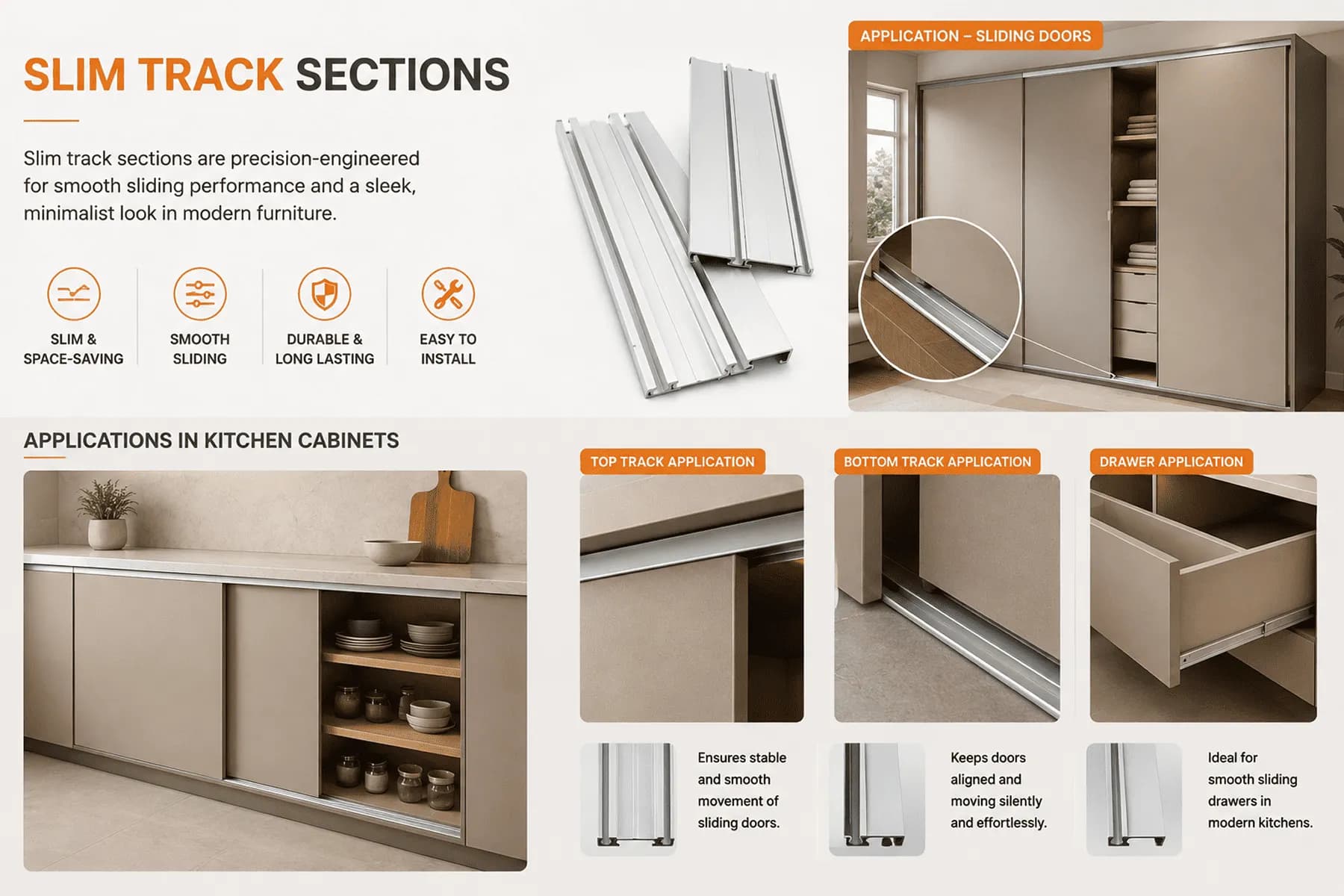
Not every sliding application needs the same rail. A single wardrobe shutter sliding past a fixed panel has very different demands from a room-height partition wall made up of multiple independently sliding shutters — and aluminium track manufacturers build distinctly different sections for each job rather than one universal rail. Slim Track Sections are single-channel, low-profile rails purpose-built for lightweight interior sliding — think wardrobe shutters, glass partition doors, and light room dividers. MTrack, by contrast, is a dual-channel architectural profile designed to support two independent sliding shutters within one section, which is the detail that matters most once a project moves from a single wardrobe door to a multi-panel partition wall where two panels need to pass each other.
Specifying the wrong one rarely shows up immediately — a single-channel track can look like it's holding a job fine until you actually need a second shutter to slide independently past the first, at which point there's simply nowhere for it to run. Getting this decision right early avoids reworking an opening after the carcass or partition frame is already built, which is a far more expensive fix than choosing the correct track at the drawing-board stage.
When a Slim Track Section Is the Right Choice
For the majority of interior fit-out work — wardrobes, cabinet shutters, single sliding partition doors — a slim track section is the simpler and more discreet specification. It's designed around a few clear priorities:
- Narrow visible face — keeping the track unobtrusive at floor and head level rather than becoming a visual feature itself.
- Standard roller compatibility — the channel dimensions work with standard nylon and steel-wheeled rollers used in most sliding wardrobe and partition hardware kits, so hardware sourcing stays simple.
- Floor or head mounting — the same section works whether the system is bottom-rolling or top-hung, depending on the sliding hardware chosen for that opening.
- Durable solid construction — a solid aluminium extrusion with precision-machined channels resists wear from repeated daily sliding and delivers smoother, quieter roller movement than the plastic track systems still used in budget wardrobe hardware.
- Finish flexibility — Mill Finish for tracks fully concealed inside a wardrobe carcass where appearance doesn't matter, or Silver/Black Matte where the track stays visible at floor level.
- Standard and custom lengths — supplied in 3.0 / 3.66-metre stock lengths, or precision pre-cut to match exact site openings for bulk orders, reducing on-site waste and cutting time.
Load capacity is the other variable worth getting right before an order is placed, since it isn't a fixed number that applies to every project — it depends on the specific track profile chosen and the roller hardware paired with it. A heavier glass partition panel and a lightweight fabric wardrobe shutter don't belong on the same track-and-roller combination, even though both might technically fit into a "slim track" category. Matching the two properly, ideally with guidance from the supplier, is what keeps the sliding motion smooth for years rather than gradually getting stiffer as the rollers wear against an undersized channel.
Slim Track vs MTrack, Side by Side
| Feature | Slim Track Sections | MTrack Profiles |
|---|---|---|
| Channel Design | Single-channel track | Dual-channel — supports two independent sliding shutters in one section |
| Typical Application | Wardrobe shutters, glass partition doors, light room dividers | Multi-panel architectural partitions where two shutters need to slide independently |
| Alloy Grade | 6063 T5 aluminium (IS 733) | Part of the Architectural Systems range — see the MTrack product page for full specification |
| Standard Length | 3.0 / 3.66 Meters | See the Architectural Systems / MTrack product page for stock lengths |
| Finish Options | Silver, Black Matte, Mill Finish | See the Architectural Systems / MTrack product page for finish options |
| Roller Compatibility | Standard nylon and steel-wheeled rollers | Designed for dual-shutter roller hardware — see the MTrack specification |
The question to ask isn't 'which track is stronger' — it's 'how many shutters need to move independently in this opening.' A single wardrobe door will run happily on a slim track for its entire service life; put two independently sliding panels in the same opening and you need the second channel MTrack provides, not a wider or heavier-gauge version of the slim track.
Making the Right Call for Your Opening
In practice, the decision is less about comparing specifications line by line and more about counting shutters. If the opening has one sliding panel — a wardrobe door, a single glass partition leaf, a lightweight room divider — a Slim Track Section is the simpler, more cost-effective, and appropriately discreet choice, and it's what most interior fabricators reach for by default for everyday residential and commercial work. If the design calls for two shutters sliding independently within the same track run — common in larger architectural partition walls and bigger commercial openings — that's the point to look at the dual-channel MTrack profile instead. Getting this right at the design stage avoids a costly rework later, since the track type generally needs to be decided before the opening, the carcass, and the roller hardware are all finalised together.