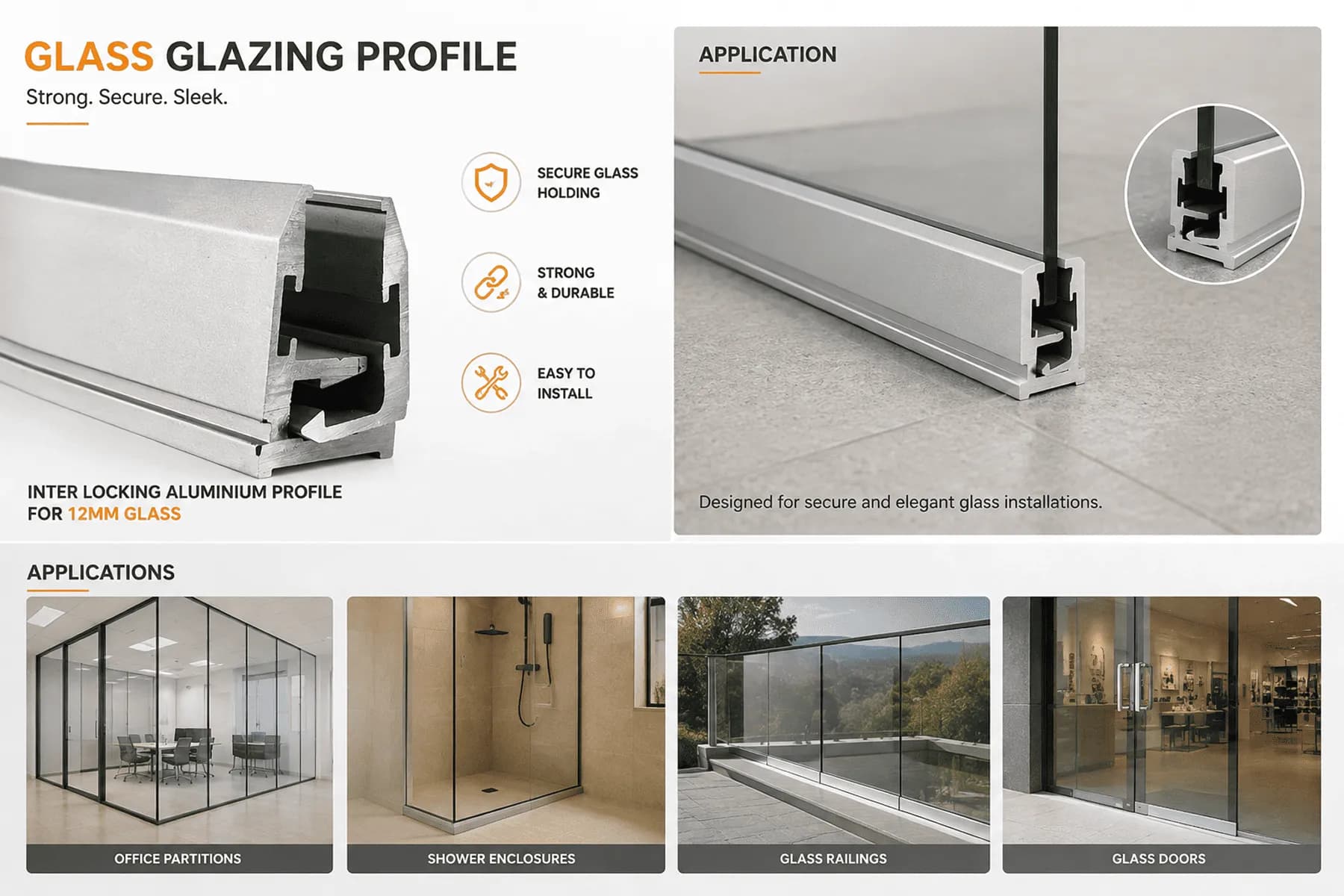
The Small Channel That Makes Frameless Glass Possible
"Frameless" glass design is something of a misnomer — the glass still needs an edge treatment, it's just designed to be as invisible as possible. That invisible edge treatment is usually a glass glazing profile: a slim U-channel aluminium section that wraps around the raw edge of a glass panel. Inside the channel sits a rubber gasket that grips the glass firmly, cushioning it against vibration and stopping direct glass-to-metal contact, which is what actually causes chipping over time. Because the channel is narrow and finished in the same anodized tones used elsewhere in a project, it reads as a clean line rather than a visible frame — which is exactly the effect designers are after when they specify a Glass Glazing Profile for a partition infill panel or cabinet door. The profile is doing real structural work even while staying visually quiet, which is precisely why it's easy to overlook until something rattles or chips.
Why Glass Edge Preparation Comes Before the Profile
A glazing profile is only as good as the glass edge it's wrapping. A flat-polished or seamed edge gives the smoothest, most consistent fit inside the channel, since the gasket seats evenly along the full length without gaps or pinch points. That said, the rubber gasket does provide some tolerance — it cushions minor edge irregularities rather than requiring a laboratory-perfect finish, which is useful to know when working with glass fabricated on a tighter schedule or budget. Fabricators specifying glass for a frameless-look project should still request a seamed or polished edge wherever the budget allows, since it noticeably improves how flush and consistent the finished channel looks along its full run, especially where the top edge of a partition panel remains visible above head height.
Matching the Gasket to Glass Thickness
The gasket cavity inside the channel has to correspond to the glass thickness being used, and this is the single most important spec decision in the whole detail. Standard glazing profiles are built to accommodate:
- 4mm to 6mm glass — typical for lighter cabinet doors and smaller decorative panels where weight isn't a major structural concern.
- 6mm to 8mm glass — common in partition infill panels and mid-size glass doors seeing everyday office use.
- 8mm to 10mm glass — used where a partition panel needs extra rigidity or acoustic mass, such as a taller cabin wall.
Getting this wrong in either direction causes problems: too loose, and the panel rattles in its frame every time a nearby door closes; too tight, and the glass edge is placed under stress it was never designed to carry, which can show up as a crack weeks or months after handover, long after anyone would think to trace the cause back to the glazing.
We size the gasket cavity to the exact glass thickness the client specifies — never to a generic "standard" size. A gasket that's even half a millimetre too tight can put enough pressure on a glass edge to cause a hairline crack months after installation, well after anyone would think to blame the glazing.
Where This Detail Shows Up, and How It's Finished
Glazing profiles do their most visible work in partition infill panels, where they finish the top, bottom, and side edges of glass set into a partition frame — the Glass Partition Profiles system is the structural frame this glazing detail typically sits inside, and the two are usually specified together rather than as separate line items. Beyond partitions, the same U-channel finishes cabinet glass doors and standalone decorative panels, anywhere a raw glass edge would otherwise be exposed to knocks or fingers. It's a genuinely versatile detail: the same profile that finishes a wardrobe's glass shutter can just as easily wrap an office cabin's full-height partition infill, provided the gasket has been matched to the right glass thickness for each. Because the aluminium is anodized, it also holds up reasonably well in covered or semi-outdoor decorative panel applications, though it's primarily specified for interior work rather than fully exposed exterior glazing.
Fabrication is generally straightforward once the sizing decisions above are settled — the sections are simple to cut, mitre, and fit on-site, and don't demand specialist tooling beyond what most glass and partition fitters already carry. Glazing profiles are extruded from 6063 T5 aluminium (IS 733), the same grade used across the interior range for its precision groove-forming, and are available in Silver, Black Matte, and China Silver — Silver and Black Matte tend to be the most requested, generally chosen to blend with either an aluminium partition frame or darker cabinet hardware nearby. Supplied wholesale in 3.0 and 3.66-metre lengths with custom cutting available, the profile remains one of the simpler line items in an otherwise technical glazing specification.