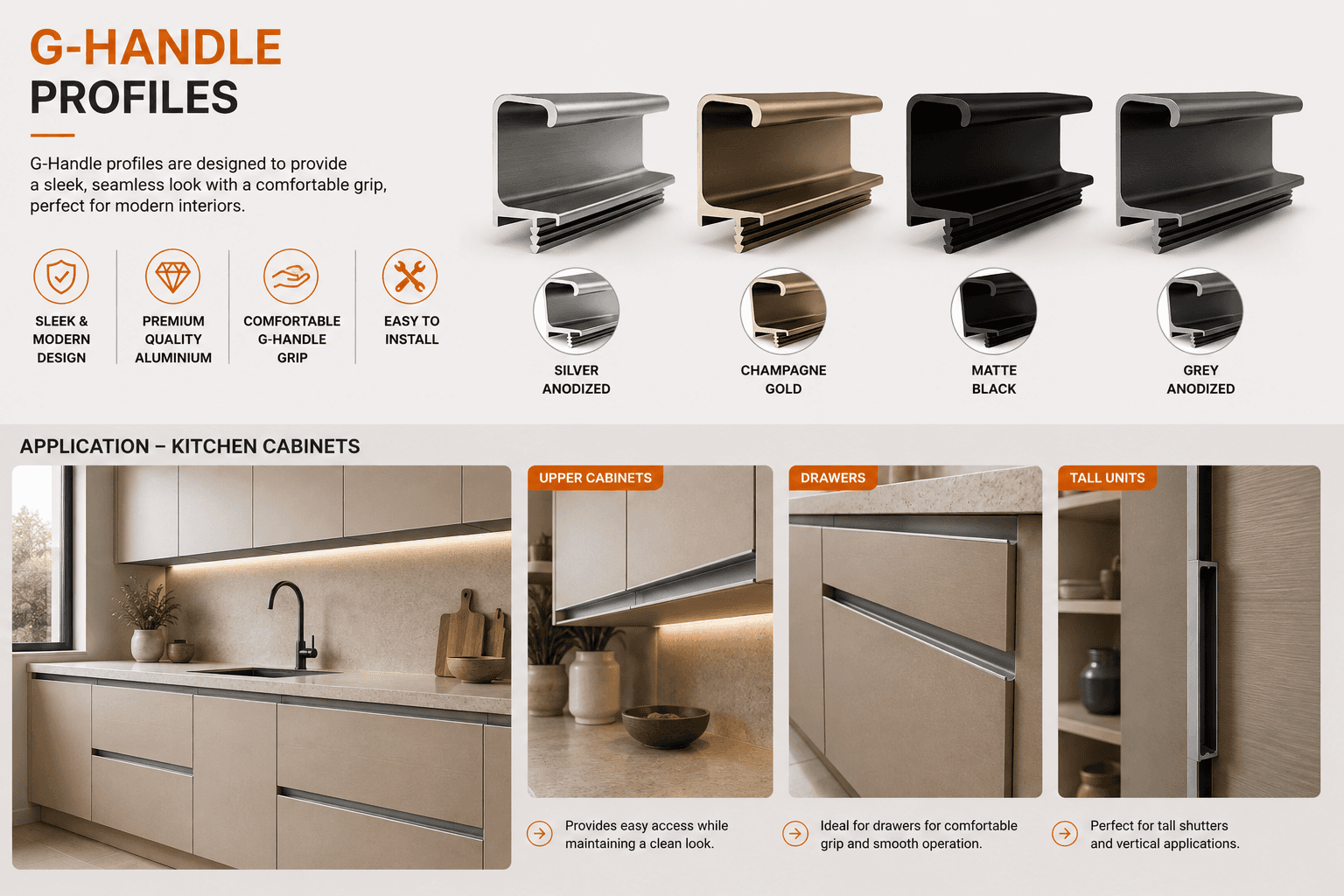
Handleless design usually gets discussed in terms of Gola channels on solid drawers and shutters, but the same philosophy applies to glass-fronted cabinets — just with a different engineering problem to solve. A glass shutter can't carry a visible external handle without breaking the clean look, yet it also can't rely on a Gola channel cut into a solid panel edge. The G-Shape handle profile solves this by building the grip directly into the glass frame itself, rather than treating the frame and the handle as two separate parts that have to be sourced, aligned, and fitted independently.
The Handleless Idea Applied to Glass Shutters
Systems like the C-Gola profile achieve a handleless look on solid drawers by recessing a channel into the cabinet carcass, which works because there's a solid panel edge to cut into. A glass shutter doesn't offer that option — the frame itself is the only structural element available to carry a grip. G-Shape frames solve this by combining the structural glass-holding frame and the handle into a single aluminium extrusion, so the shutter gets a true handleless appearance without needing a separate recessed channel anywhere on the glass or the cabinet.
How the Integrated Grip Actually Works
The G-Shape profile includes a concealed rear pull channel — a recessed section on the back or bottom edge of the frame — that lets a user hook their fingers behind the frame without ever touching the glass face itself. From the front, the frame reads as a normal, slim aluminium border; the handle function is tucked away rather than announced. It's manufactured from 6063 T5 aluminium conforming to IS 733 for the dimensional precision the integrated channel needs to stay structurally sound over years of repeated use, which matters more here than on a plain frame since the pull channel is part of the load-bearing section, not an add-on.
- Glass compatibility — groove sized for 4mm to 5mm toughened or clear glass panels
- Hardware compatibility — works with standard soft-close hinges and hydraulic lift-up systems
- Mounting position — bottom-edge pull design suited to both overhead wall units and base cabinet glass shutters
- Finish options — Black Matte, Gold, Silver, and China Silver
- Supply format — bulk 3.66-metre lengths with custom cutting available for large orders
G-Shape vs a Standard Shutter Frame Plus Handle
A standard aluminium profile shutter frame — available in slim 20mm or wider 40-50mm series — does an excellent job of framing and protecting a glass panel, but it still needs a separate handle fitted somewhere on the shutter face or edge to be opened. That's the right choice when a visible handle is part of the design language, or when the dealer wants the flexibility of pairing any handle style with any frame width. G-Shape trades that flexibility for a cleaner result: one profile, one order, one finish to match, and no separate hardware line to source or align during fabrication. The decision usually comes down to whether the brief calls for a visible handle detail or a completely uninterrupted glass surface.
Where G-Shape Frames Are Typically Specified
Because the pull is accessed from the bottom edge, G-Shape frames are most commonly specified on overhead wall units, where a lift-up or hinged glass shutter needs to open from below without a handle interrupting the display. The same frame also works on base cabinet glass shutters, though it's less frequently the default choice there since base units have more room for other handle styles. Black Matte is the most requested finish for these installations, since it keeps the frame visually quiet against the glass, while Gold is more often chosen for premium display cabinets where the frame is meant to be noticed.
An integrated handle only works if nobody has to think about where to grip — if a user hesitates or fumbles for the pull on a glass door, the frame has failed at the one thing it was designed to hide.
Specification Mistakes to Avoid
Because a G-Shape frame looks similar to a standard glass shutter frame at a glance, a few avoidable mismatches tend to show up when it isn't specified carefully:
- Assuming any standard 20mm or wide profile shutter frame can be swapped in for a G-Shape frame without checking clearance for the concealed pull channel
- Choosing Silver or China Silver for a premium display cabinet where Gold or Black Matte would suit the integrated-handle look better
- Fitting soft-close hinges or lift-up systems without first confirming their mounting dimensions against the G-Shape frame's bottom-edge pull design
- Specifying G-Shape on a base cabinet run where a visible handle style was actually the preferred look for that zone
Because the frame and the handle are a single extrusion rather than two separate purchases, ordering G-Shape frames in bulk is also simpler from a procurement standpoint — one profile line, one finish, and one cut-length schedule covers what would otherwise be a frame order plus a separate handle order. For a kitchen that combines glass overhead units with a fully handleless base-cabinet run, G-Shape frames on top and C-Gola profiles on the drawers below apply the same design principle — no visible external hardware — using two completely different profile geometries suited to glass and solid panels respectively.