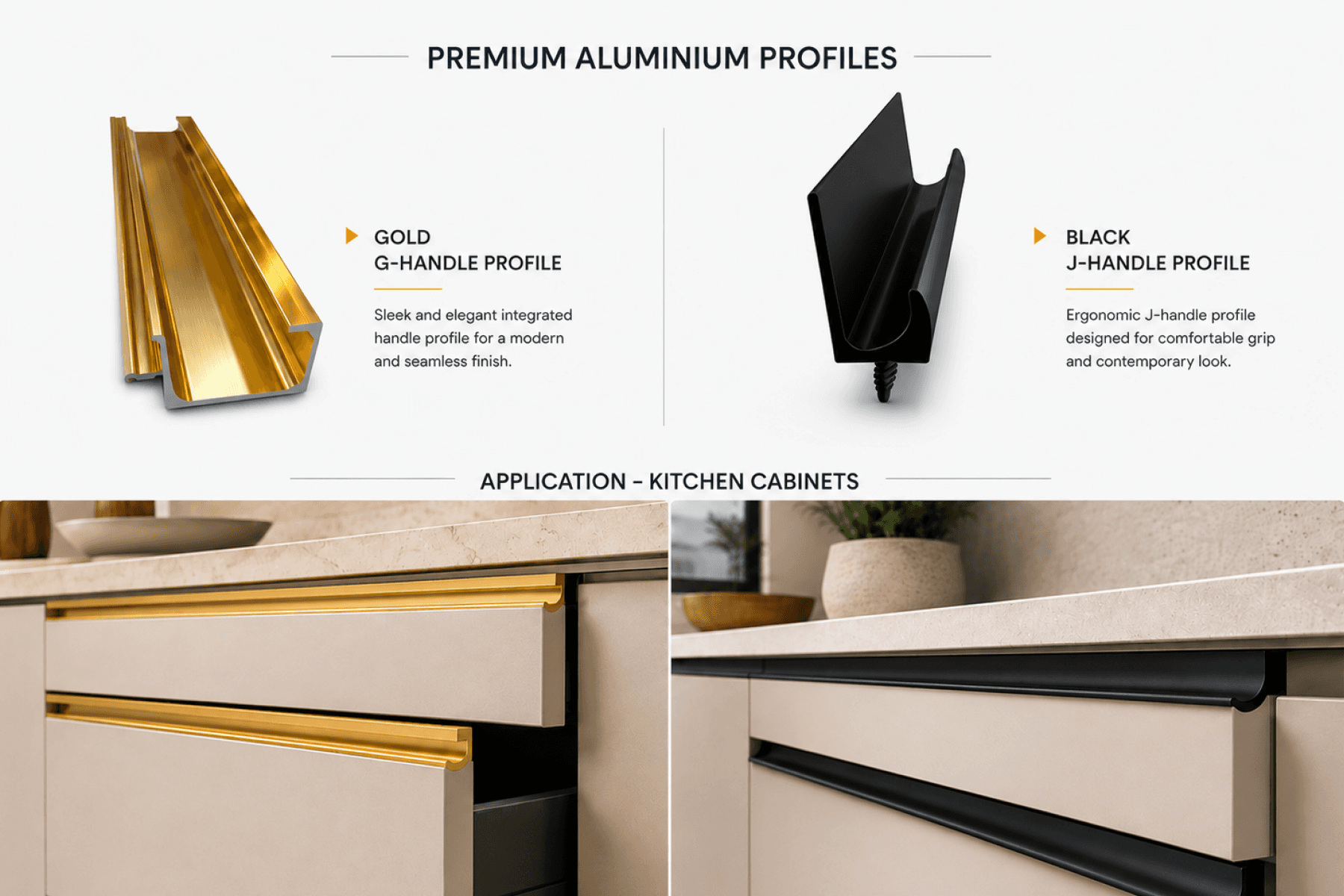
Ask a modular kitchen dealer whether a project needs a G-Handle or a J-Handle, and the honest answer in most projects is "both, on different cabinets." These two profiles come from the same product family, are extruded from the same 6063 T5 aluminium alloy, and are fitted to the shutter the same way — but they are not interchangeable in daily practice, and fabricators who treat them as one generic "handleless handle" option end up with either a drawer that feels awkward to pull or an overhead cabinet with a handle that looks heavier than it needs to.
G-Handle and J-Handle Solve the Same Problem Differently
The difference comes down to grip depth. A G-Handle offers a deeper, more pronounced grip, engineered to give a secure hold on cabinets that carry real weight — base units and drawers loaded with cookware, crockery, or pantry items that get pulled hard multiple times a day. A J-Handle, or J-pull, has a sleeker, shallower curve that trades some of that grip depth for a lower, more minimalist profile. It is the natural choice for overhead cabinets and wall units, where the load being pulled is lighter and a bulkier grip would visually dominate a shutter that sits at eye level or above.
G-Handle vs J-Handle Specifications Compared
| Specification | G-Handle | J-Handle |
|---|---|---|
| Grip Profile | Deeper, more pronounced curve for a secure hold | Sleeker, shallower curve for a low-profile look |
| Best Suited For | Base cabinets and drawers carrying heavier daily loads | Overhead cabinets and wall units, minimalist styling |
| Mounting Method | Slides onto the shutter's top or side edge; adhesive or concealed rear screws | Same edge-mount method; adhesive or concealed rear screws |
| Board Compatibility | 18mm and 19mm shutter and drawer boards | 18mm and 19mm shutter and drawer boards |
| End-Cap Hardware | Matching aluminium end-caps available | Matching aluminium end-caps available |
| Standard Length | 3.0 / 3.66 Meters | 3.0 / 3.66 Meters |
| Alloy Grade | 6063 T5 aluminium (IS 733) | 6063 T5 aluminium (IS 733) |
Because both profiles are engineered for the same 18mm and 19mm board thickness, switching between them across a single kitchen never becomes a fabrication headache — the same shutter and drawer boards accept either profile without modification. This is exactly why the more common real-world specification is not "G or J" but a deliberate mix: J-Handles running along overhead wall units for a light, minimal look, and G-Handles reserved for base cabinets and drawers where a firmer grip actually matters day to day.
Matching the Handle to the Cabinet, Not the Whole Kitchen
A practical way to walk through a cabinet-by-cabinet specification is to ask the same questions for every unit in the layout:
- Is this an overhead or wall-mounted cabinet, where a lighter, low-profile J-Handle keeps the visual weight of the shutter down?
- Is this a base cabinet or drawer that will carry heavier daily loads, where a G-Handle's deeper grip earns its slightly bulkier appearance?
- Does the client want a uniform handle style throughout, or are they comfortable with J-Handles above and G-Handles below — the more common professional specification?
- Which finish is being used elsewhere in the kitchen, since both profiles share the same finish palette and can be mixed without a visible mismatch?
- Is this a bulk order where custom cut-to-length pieces should be specified now to reduce on-site cutting waste across dozens of cabinets, especially on a large OEM order with many identical units?
Both profiles are fixed the same way — slid onto the shutter edge and secured with either high-strength industrial adhesive or small countersunk screws driven in from the back, so no fixing hardware is ever visible on the front face. Matching aluminium end-caps are available for both G and J sections, which is a detail worth specifying up front rather than as an afterthought, since an exposed raw aluminium end on a visible cabinet corner looks noticeably less finished than a capped one.
The profile geometry behind the grip is precision-extruded to keep its radius consistent along the full length of the section, which matters once a workshop starts cutting dozens of handles from the same 3.0 or 3.66-metre length for one project — every piece, whether cut from the start or the end of the length, needs to feel identical in the hand once fitted, and tight-tolerance extrusion is what actually delivers that consistency rather than luck. This is easy to overlook when comparing two profiles on a sample board, but it becomes obvious the moment a hundred cabinets are fitted with handles cut from different lengths and one section feels slightly looser than the rest.
Finish Trends and Choosing Between the Two Families
Finish choice tends to follow current design trends more than functional differences between the two shapes. Rose Gold and Black Matte are currently the most requested finishes for luxury modular kitchens, while Silver and Gold remain the steadier choice for classic and commercial fit-outs where a more neutral metallic tone is expected. Beyond these four core anodized tones, Brush Finish and Blasting Finish textures are also offered across the range for projects that want a more tactile surface than a plain gloss or matte anodize. For large OEM orders, custom cut-to-length service is also available on both profiles, which is worth specifying at the order stage so cabinets arrive pre-sized rather than needing rework in the workshop.
For dealers weighing whether a project needs G and J-Handles at all, it is worth remembering these two are not the only route to a handleless look. Where the brief calls for an even flatter shutter face than either edge-mounted profile can deliver, an inset i-Handle profile sits within a routed groove rather than on the surface — a genuinely different mounting philosophy, and one worth comparing before assuming G or J is automatically the right family for every cabinet in the layout.
The mistake we see most often is a fabricator specifying one handle profile for an entire kitchen because it is simpler to order — a J-Handle on a heavy pot-and-pan drawer will work, but it will never feel as secure as a G-Handle was actually engineered to on that exact cabinet.
Dealers planning a mixed specification across a project, or comparing G and J-Handles against the more minimalist i-Handle profiles for certain cabinet runs, can review the full finish and length specification for G-Handle and J-Handle profiles to plan bulk quantities across both grip styles in a single wholesale order.