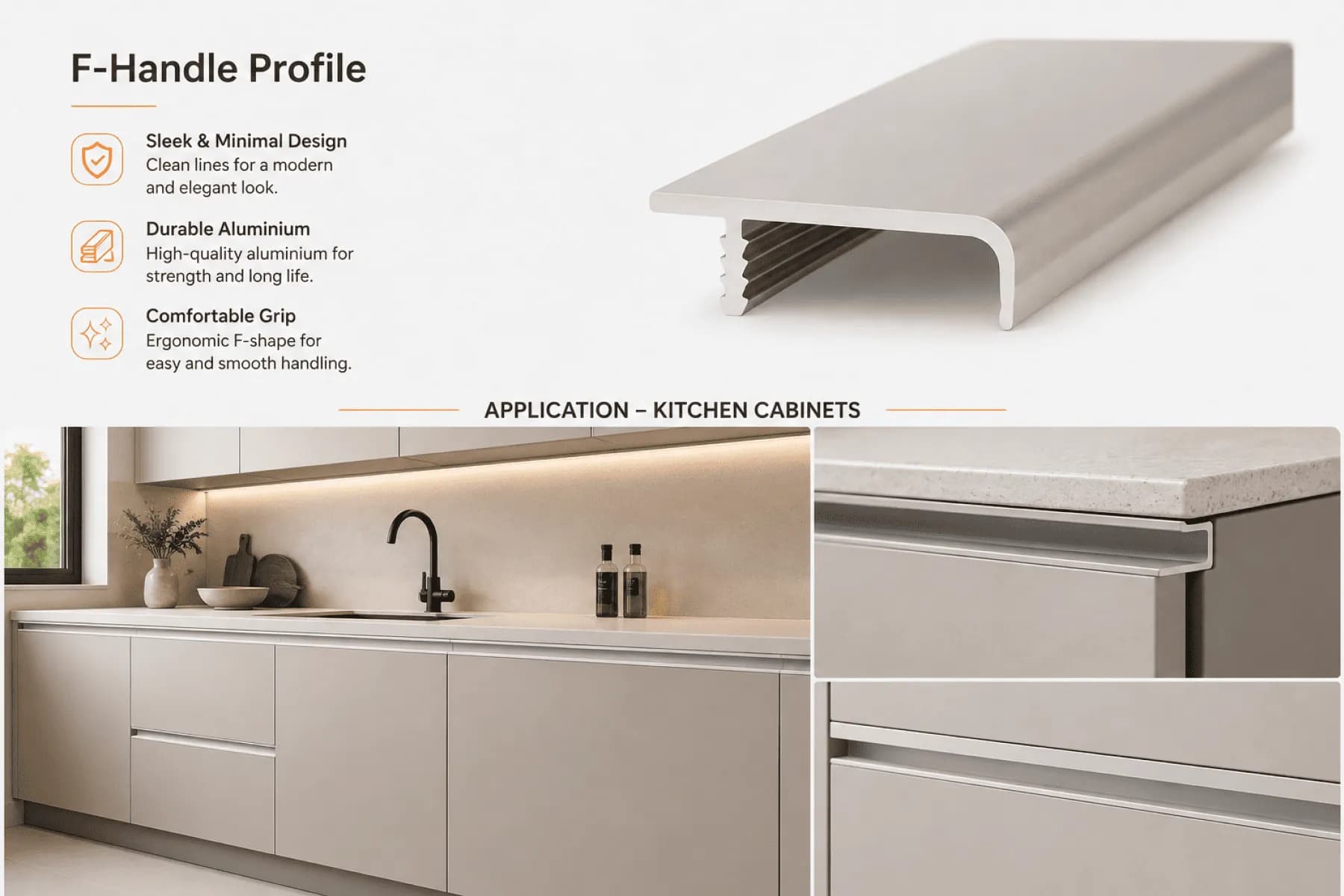
Handleless kitchens are usually associated with recessed Gola channels, but very few kitchens are ever completely free of grip hardware from top to bottom. Overhead wall units and tall pantry columns sit at a height where a deep recessed channel is awkward to reach into, which is exactly the gap the F-Handle profile is built to close. Rather than being a compromise, the F-Handle is a deliberate design choice for the parts of a kitchen where a different grip geometry works better than a Gola channel or a bulky external pull. Knowing exactly where it belongs in a layout — and where it doesn't — saves a dealer from specifying the wrong hardware for a cabinet zone that behaves differently from the rest of the kitchen.
The Grip Problem at Height
Base cabinet drawers sit roughly at hip height, so a recessed finger-pull is easy to use with a natural downward hand motion. Overhead cabinets and tall wardrobe or pantry shutters are different — the hand often approaches from below or at an angle, and a deep recess can be hard to locate by feel. A handle that projects too far, meanwhile, adds visual bulk exactly where a kitchen's upper sightline is most exposed. Fabricators specifying hardware for wall units and tall units are really solving an ergonomics problem first and an aesthetics problem second, which is why this zone is usually specified separately from base-cabinet Gola systems rather than simply extending the same channel upward.
How the F-Handle Profile Answers It
The F-Handle is a slim, wall-mounted grip profile with a shallow, flat-faced cross-section that sits close to the shutter surface instead of projecting outward or recessing deep into the carcass. That shallow depth is what makes F-Handle profiles workable on overhead units, where cabinet depth is already tight, and on tall wardrobe shutters, where a vertical grip needs to run the height of the door without looking like an afterthought. Because the section is manufactured from 6063 T5 aluminium conforming to IS 733, it holds its shape over the long spans typical of tall units while remaining light enough for overhead mounting, and the fixed cross-section keeps the grip consistent whether it's cut for a short wall cabinet or a full-height pantry door.
- Panel compatibility — engineered for standard 18mm and 19mm modular kitchen and wardrobe panels
- Mounting orientation — works horizontally on overhead cabinets or vertically along tall wardrobe and pantry edges
- Hardware compatibility — a surface grip design that doesn't interfere with soft-close hinges
- Finish options — Silver, Black Matte, China Silver, and Grey
- Finishing accessories — matching aluminium end-caps for a clean line at both ends
- Supply format — bulk 3.0m and 3.66m lengths with custom cutting for large orders
F-Handle Compared to Other Handle Profiles
A dealer's handle catalogue usually has more than one option that could technically fit an overhead cabinet, so it helps to know how F-Handle sits relative to the alternatives. i-Handle profiles are slim inset sections built for flush integration into the shutter edge, which suits contemporary base and mid-height cabinets more than the reach-up condition of an overhead unit. G-Handle and J-Handle systems build an ergonomic grip directly into the shutter profile itself, which changes the shutter's edge geometry rather than adding a separate mounted section. The Kitchen Shutter Handle is a surface-mounted bar profile, closer in spirit to F-Handle but generally deeper and more visually prominent. F-Handle's advantage for overhead and tall units specifically is its shallow, flat-faced section — it adds a secure grip without the added depth or shutter-edge rework the other options bring with them, which is why it tends to be the default recommendation once a cabinet run moves above eye level.
Matching Finish to the Application
Not every F-Handle finish is chosen for looks alone. Grey and Black Matte powder coats are the two finishes called out for UV stability, which matters on balcony utility cabinets and semi-outdoor kitchen extensions where direct sunlight would dull a plain anodized surface over time. Silver and China Silver, by contrast, are better suited to indoor overhead units where the priority is matching brushed steel appliances or matte-silver hardware elsewhere in the kitchen. Getting this pairing right at the design stage avoids a mismatched or weathered handle line a few years after installation, and it's a far cheaper decision to get right on paper than to correct once the shutters are already hung and hinged.
On tall units, the handle profile has to do a full day's work in a spot nobody can easily replace later — get the finish and the mounting orientation right the first time, because re-fitting a wardrobe shutter edge after installation is rarely simple.
Before You Place a Bulk Order
- Confirm whether the application is overhead (horizontal run) or a tall unit (vertical run) — this affects cut length planning and how many end-caps to order.
- Check panel thickness against the 18mm/19mm compatibility range before finalizing cabinet drawings, so the grip section lines up with the shutter edge.
- Decide on end-cap finishing at the same time as the main profile order, so both pieces arrive in the exact same finish batch.
- Flag any semi-outdoor or balcony utility units so Grey or Black Matte can be specified for UV stability from the start.
- Confirm cut-to-length requirements against standard 3.0m and 3.66m stock lengths for large-volume orders to minimise offcut waste.
For dealers building out a full kitchen hardware plan, the F-Handle rarely works in isolation — it usually sits alongside recessed Gola channels on base cabinets and other grip profiles across the rest of the layout. Browsing the complete kitchen aluminium profiles range makes it easier to plan a consistent handle and finish strategy across overhead, tall, and base units before placing a bulk order, rather than sourcing each cabinet zone's hardware from a different supplier at a different time.