How Do You Know an Edge Needs a Corner Guard?
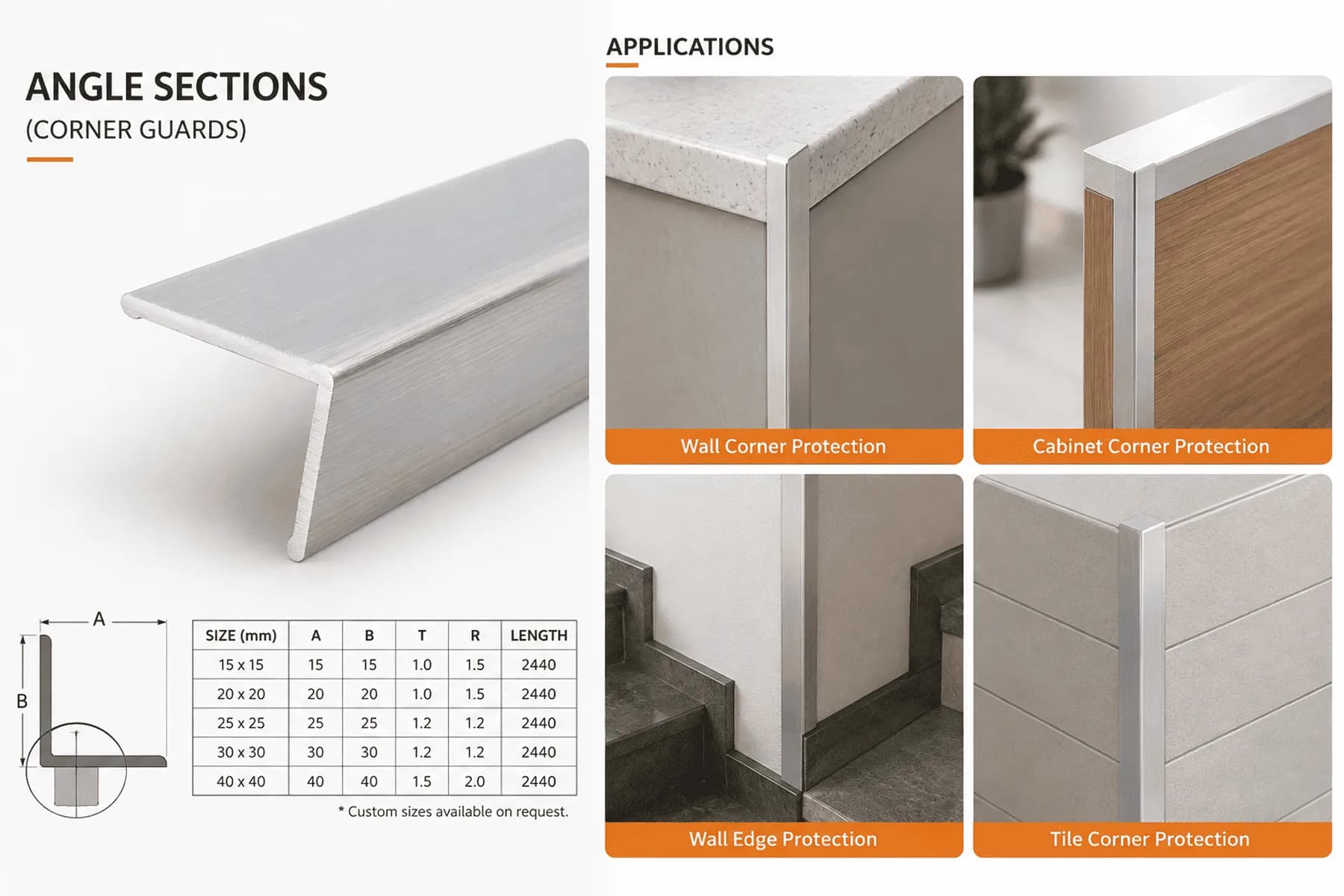
Not every wall corner in a building needs protecting, but a surprising number of interior specifications skip this detail until the damage has already happened. The giveaway is usually foot and cart traffic: any corridor, corner, or doorway edge that regularly meets a wheeled trolley, hospital bed, luggage cart, or even a vacuum cleaner is a candidate for an aluminium angle section, more commonly called a corner guard. Left unprotected, plaster and paint at these corners chip within months, and repainting a hospital corridor every year is a far more expensive habit than fitting a guard once. The Angle Sections (Corner Guards) range is built specifically for this — L-shaped extrusions engineered to take repeated impact without denting or peeling, so the same corner still looks sharp several years into daily use.
Where Corner Guards Earn Their Cost
The corners most worth auditing on any project walkthrough include:
- Hospital and clinic corridors — where gurneys and equipment carts strike corners dozens of times a day, often at speed during emergencies.
- Hotel and hospitality corridors — housekeeping trolleys and luggage carts concentrated in narrow service passages that see constant back-and-forth traffic.
- Retail aisles and stockrooms — shopping trolleys and pallet trucks moving through tight turns where a miscalculated corner is inevitable.
- School and childcare corridors — where radius-edge guards double as a safety feature, not just a durability one, given how much faster children move through corners.
- Commercial kitchens and back-of-house zones — heavy equipment and trolley movement in confined spaces where walls take a beating that public-facing areas rarely see.
Sizing, Edge Shape, and Installation Method
Once you've identified a high-traffic edge, the next decision is sizing. Angle sections are stocked from 12x12mm up to 50x50mm, in both equal-leg and unequal-leg configurations — equal legs suit a symmetrical protective corner, while an unequal-leg section is useful where one face needs to be wider to cover an irregular corner, an uneven plaster line, or where the angle is doing double duty as a structural framing edge rather than a purely protective one. Wall thickness matters just as much as leg size: sections run from 1.0mm to 3.0mm, and a decorative corner in a low-traffic lobby doesn't need the same wall thickness as a corridor absorbing daily cart impacts. Specifying the thinner end of that range purely to save cost on a corridor that sees heavy daily traffic is a false economy — the guard ends up dented within a year or two, which looks worse than having fitted nothing at all.
For hospital and hotel corridors specifically, we point specifiers toward the 2.0mm to 3.0mm wall thickness range — anything thinner tends to dent under repeated trolley impact within a couple of years, which defeats the purpose of fitting a guard in the first place.
Standard L-angle sections give a crisp, architectural corner line that suits offices and retail interiors where the priority is a clean, minimal look. In healthcare and childcare settings, however, a radius-edge corner guard is generally the safer specification, rounding the exposed edge to reduce injury risk from an accidental collision at speed. Both versions are extruded from the same 6063 T5 aluminium (IS 733) and share the same finish and thickness range, so switching between the two profile shapes doesn't limit your options elsewhere in the specification or force a different finish order. It's also worth remembering that the same L-shaped extrusion doubles as a decorative frame or a lightweight structural support elsewhere in a fit-out, wherever a clean 90-degree metal edge is needed rather than a rounded or invisible one.
For lighter-duty or retrofit jobs, angle sections are available with pre-applied high-bond double-sided tape, letting a contractor fit a guard in minutes without wet trades or drying time. For industrial or higher-impact installations, a silicone-based adhesive is the more durable option and is generally recommended wherever the guard will face sustained daily impact rather than occasional contact. Either way, the anodized finish is weather-resistant enough that the same guard works equally well on an exterior-facing corner exposed to rain and sun, which is worth knowing if the corridor in question opens onto a covered walkway or loading area.
A Deliberate Design Element, Not Just a Guard
It's easy to think of corner guards purely as a maintenance decision, but they're increasingly specified as a visible design line too — a Black Matte or Grey angle section run along a feature wall reads as an intentional architectural detail rather than a retrofit patch bolted on after the fact. Once you're comparing finishes and sizes across a project, it's worth browsing the full Interior & Decorative catalogue alongside the angle sections, since skirting and T-profile inlays are often specified in the same finish to keep hardware consistent throughout a fit-out, and ordering them together simplifies both procurement and colour-matching across trades. For commercial fit-out specialists ordering at scale, angle sections are supplied wholesale in 3.66-metre lengths, which is worth factoring into how a corridor's corner runs are measured and quoted before an order is placed.