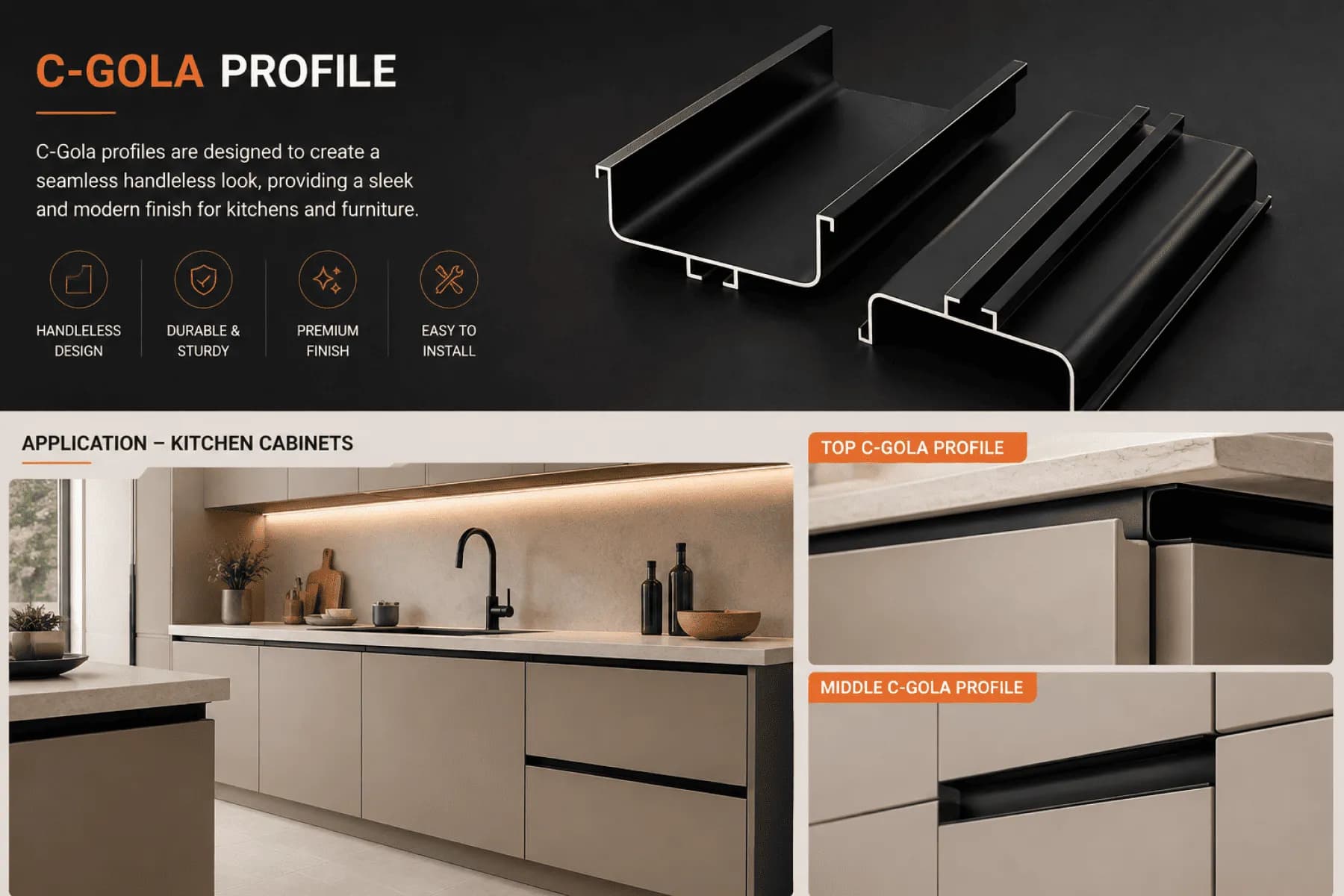
A handleless kitchen rarely relies on a single Gola profile throughout — most layouts pair two different channel shapes depending on where the grip needs to sit. The C-Gola profile and the L-Gola profile are both aluminium handleless channels manufactured from the same alloy, but their cross-sections are built for different jobs. Understanding the structural difference between a double-sided mid-cabinet channel and a single-sided right-angle channel makes it far easier to specify the correct profile for each part of a layout, rather than defaulting to whichever one a fabricator happens to have used on the last project.
How the Two Channels Differ Structurally
The C-Gola is a double-sided horizontal profile installed within the cabinet carcass between two drawer fronts, creating one continuous recessed channel that both the drawer above and the drawer below can grip. The L-Gola, by contrast, is a single-sided, right-angle channel — its L-shaped cross-section is designed to sit along the underside of an overhead cabinet or the vertical edge of a tall unit, where only one shutter needs a grip point rather than two. Both are extruded from the same 6063 T5 aluminium conforming to IS 733 and supplied wholesale in 3.66-metre lengths, so the underlying material and stock-length economics are identical — the decision comes down to where in the cabinet the grip sits and how many shutters share it.
- Is the profile sitting between two drawer fronts that both need access, or only serving one shutter edge?
- Does the cabinet zone sit at mid-height on base drawers, or along the top or vertical edge of overhead and tall units?
- Will the layout include L-shaped or U-shaped runs that need corner connectors to keep the channel continuous?
- Which finish palette is already specified elsewhere in the kitchen — warm tones or matte and silver tones?
| Feature | C-Gola Profile | L-Gola Profile |
|---|---|---|
| Alloy Grade | 6063 T5 (IS 733) | 6063 T5 (IS 733) |
| Channel Shape | Double-sided horizontal channel | Single-sided right-angle (L-shaped) channel |
| Typical Position | Horizontal, between two drawers | Horizontal (overhead underside) or vertical (tall unit edge) |
| Drawer/Shutter Access | Grips drawer above and below | Grips one shutter edge |
| Finish Options | Rose Gold, Gold, Black Matte, Black Glossy | Black Matte, Silver, Rose Gold, Gold |
| Standard Length | 3.66 Meters | 3.66 Meters |
| Best Suited For | Base cabinet drawer stacks | Overhead wall cabinets and tall pantry/wardrobe units |
Choosing Based on Cabinet Layout
For a straightforward run of stacked base drawers, the C-Gola is the natural choice since one channel installed between each pair of drawers serves both. Once the layout moves to overhead wall cabinets or a tall pantry column, there's typically only one shutter edge to grip, and mounting depth is tighter — this is where the L-Gola's shallow right-angle section and hidden-from-the-front geometry does the job the C-Gola isn't shaped for. Most complete handleless kitchens end up specifying both: C-Gola down the base run, L-Gola along the overheads and tall units, connected visually through a shared finish rather than a shared profile shape.
Treat C-Gola and L-Gola as one family with two jobs, not as competing products — matching the finish across both is what makes the whole kitchen read as a single handleless system, even though the channel shapes underneath are completely different.
Installing and Finishing Both Channels
Installation for either channel follows a similar process: a cutout is made in the relevant cabinet side-panels, and the profile is then secured in place with mounting brackets, which keeps fitting straightforward for fabricators already used to standard modular kitchen carcass work. Because both channels see constant hand contact — C-Gola from opening drawers above and below, L-Gola from daily use on overhead and tall-unit shutters — the anodized surface on both is chosen to resist fingerprints and staining rather than just to look good on day one. Neither channel interferes with soft-close drawer runners or standard hinge hardware, so the choice of C-Gola or L-Gola never has knock-on effects on the rest of the cabinet's fittings.
Common Layout Mistakes to Avoid
Because both profiles get grouped together under the general label "Gola system," it's easy for a layout plan to specify the wrong one for a given cabinet zone, especially when drawings are reused from a previous project. A few recurring mistakes are worth checking for before an order is finalised:
- Ordering only C-Gola for a kitchen that also has overhead wall units, leaving those shutters without a matching handleless channel
- Mixing finishes between the base run and the overhead run without first checking whether both channels are actually available in that shade
- Forgetting to order corner connectors upfront for L-shaped or U-shaped runs, leading to a visible joint break mid-project
- Specifying L-Gola on a base cabinet where two drawers actually need to share one channel, which calls for C-Gola instead
Using Both Together in One Project
Because both profiles share the same alloy and stock length, ordering them together for a single project is straightforward from a procurement standpoint — the differences that matter are cut lengths per cabinet type and finish selection, not sourcing logistics. Fabricators should also confirm corner connector availability early: both channels rely on internal and external 90-degree connectors to stay continuous through L-shaped or U-shaped kitchen runs, so these should be ordered alongside the main profile rather than as an afterthought. Planning the base-cabinet and overhead quantities together, rather than raising two separate purchase orders at different stages of the project, also makes it easier to lock in a consistent finish batch across the whole kitchen. The L-Gola profile page carries the complete finish and mounting details for the overhead and tall-unit channel, while the C-Gola profile page covers the base-cabinet channel in full.