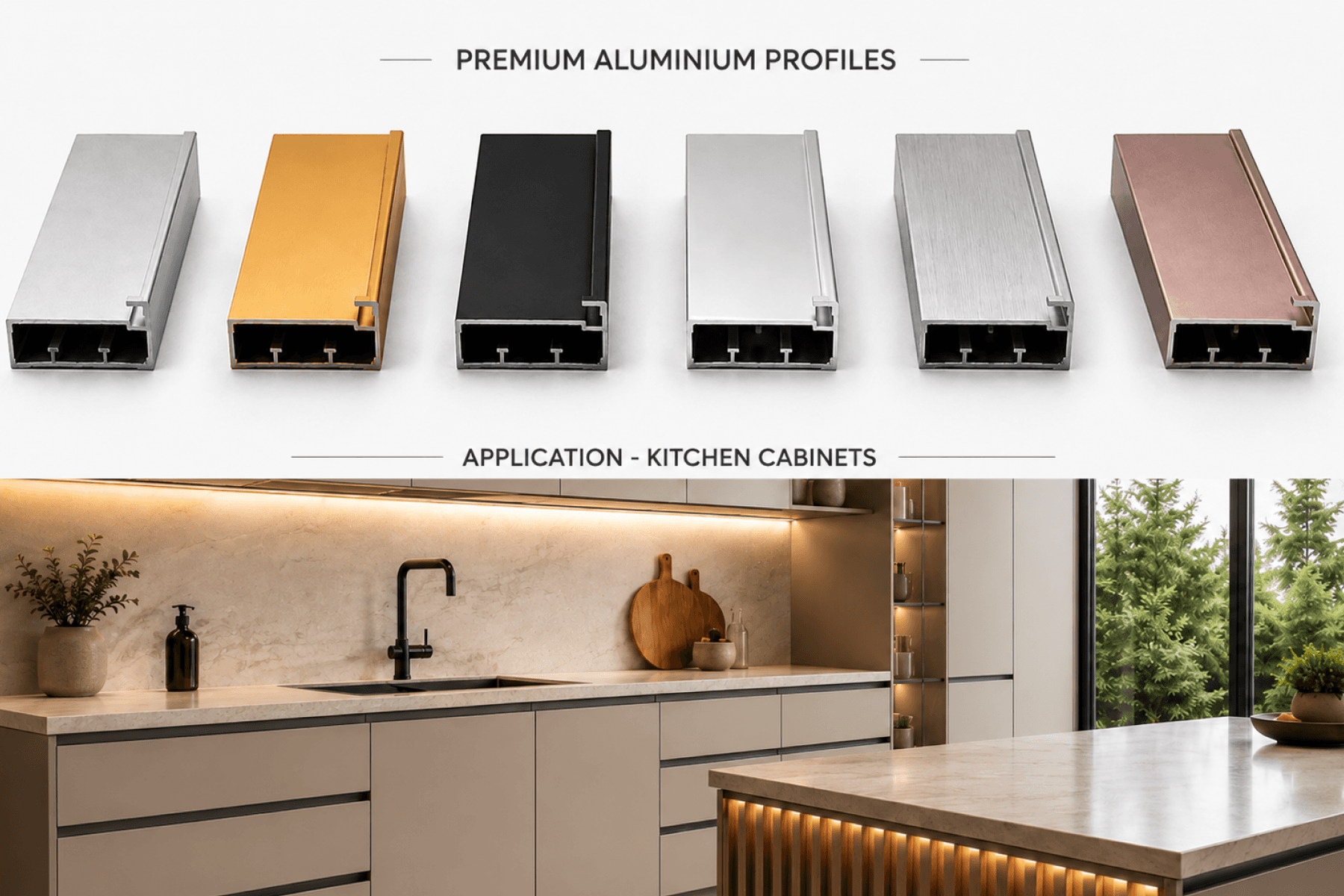
Traditional wooden and MDF shutter frames have been the default choice in Indian modular kitchens for decades, largely because they are familiar to carpenters and easy to source locally. But a kitchen is one of the most hostile environments in a home for any wood-based material, and frame edges — the exposed border around laminate or acrylic shutters — are almost always the first place damage shows. Steam, spilled water, and repeated wiping concentrate exactly where a wooden frame is most vulnerable: at the join between the panel core and its edge banding. Fabricators who have reworked enough call-back jobs already know the pattern, even if they have never put a name to what causes it.
Where Wooden Shutter Frames Actually Start to Fail
The core issue is moisture ingress at the edge. Once water gets past a wood or MDF edge-band, even in small amounts, the core begins to swell from the inside out. This swelling is rarely visible at first — it shows up months later as a lifted laminate corner, a slightly warped shutter that no longer closes flush, or a musty smell developing inside the cabinet. Because the damage starts inside the panel, by the time it is visible the frame usually needs full replacement rather than a simple repair, which is an expensive and disruptive fix for a homeowner and a reputational risk for the fabricator who installed it.
How Aluminium Framing Changes What Happens at the Edge
Aluminium shutter frames solve this differently by changing what happens at the edge rather than trying to seal wood better. A frame extruded from 6063 T5 aluminium fully encases the exposed edge of the laminate or acrylic panel, physically blocking moisture from reaching the point where edge-banding typically fails first. Because the frame is metal rather than a porous, wood-based material, there is no core left for water to swell — the same mechanism that causes long-term wood failure simply does not exist in an aluminium section. This is why aluminium framing has become the standard choice for fabricators building in kitchens, bathrooms, and other high-humidity rooms rather than dry furniture like bedroom wardrobes.
Panel thickness compatibility is another detail that separates the two on site. Aluminium shutter frame sections are engineered specifically for the 18mm and 19mm board thicknesses used across Indian modular kitchen manufacturing, so the frame sits flush against the panel without a visible gap. Wooden edge-banding, by contrast, is applied by hand or on an edge-banding machine and depends heavily on operator skill for a tight, gap-free finish — inconsistent even across shutters from the same batch. Corner finishing follows a similar pattern: aluminium frames cut at a clean 45-degree mitre give a seamless joint, and fabricators can add a slight filing pass or dedicated aluminium corner connectors for a smooth, child-safe edge, whereas mitred wood joints tend to open up slightly as the material moves with humidity over time.
Fabrication speed also favours aluminium once a workshop has the right blade. These frame profiles cut cleanly with a standard mitre saw fitted with an aluminium cutting blade, so no specialised machinery is required beyond what most modular kitchen workshops already own, and the frames are supplied wholesale in standard 3.66-metre lengths that a fabricator cuts down to size per shutter. This keeps the switch from wood to aluminium framing a workflow change rather than a capital investment.
Aluminium vs Wooden Shutter Frames at a Glance
The two approaches differ across nearly every practical dimension a fabricator has to plan around, from the raw material and moisture behaviour through to how the finished corner is cut and joined on site.
| Feature | Aluminium Shutter Frame | Wooden / MDF Frame |
|---|---|---|
| Core Material | 6063 T5 aluminium (IS 733) | Solid wood or MDF core with edge-banding |
| Moisture Behaviour | Encases the panel edge, blocking moisture ingress at the join | Prone to swelling and edge-lift once moisture reaches the core |
| Panel Compatibility | Laminate, acrylic, and engineered wood at 18mm / 19mm thickness | Typically limited to wood-based board types |
| Finish Options | Silver, China Silver, Black Matte, Black Glossy, plus custom RAL on bulk orders | Paint, veneer, or laminate wrap finishes only |
| Fabrication Method | Standard mitre saw with an aluminium blade, no special machinery | Standard woodworking tools; joints more prone to chipping over time |
| Typical Use Case | Kitchens, bathrooms, and other high-humidity, high-wear cabinetry | Dry furniture and traditional wood-grain aesthetic projects |
Cost is the one area where wood still has an edge at the quoting stage, and it is worth being upfront about that with clients rather than overselling aluminium as universally cheaper. Aluminium framing carries a higher material cost per running metre than a basic wooden edge. The trade-off is on the maintenance side of the ledger: a wooden frame that needs replacing within a few years due to edge swelling ends up costing the client, and often the fabricator's reputation, far more than the small premium paid upfront for a frame that does not need replacing at all.
A shutter frame that fails at the edge almost never fails because of a bad design — it fails because the material chosen for that specific edge could not handle the moisture the kitchen actually produces every single day, not the moisture it was tested for in a showroom.
Choosing Between the Two for Your Next Kitchen Project
For fabricators deciding between the two on an upcoming order, a few practical questions help settle it quickly:
- Is the cabinet in a wet zone (near a sink, hob, or dishwasher) or a genuinely dry zone like an overhead pantry unit?
- Does the client want a metallic edge line, or is a seamless wood-grain look part of the brief?
- Will the shutters need to match acrylic or high-gloss laminate, materials that show frame gaps more visibly than matte finishes?
- Is this a bulk B2B order where consistent finish across dozens of units matters more than a one-off custom look?
- Does the project need a custom RAL shade to match a brand colour, which aluminium framing supports but a painted wooden frame handles less predictably over time?
For glass-fronted shutters specifically, a standard framing profile is not the right fit either — those need a dedicated gasket-fitted section rather than a solid-panel frame. Fabricators evaluating the switch to metal framing for an upcoming kitchen run can review the full specification for aluminium kitchen shutter frames, including finish and panel compatibility, and browse the wider kitchen aluminium profiles range to match cabinet, handle, and frame sections from a single wholesale supplier.