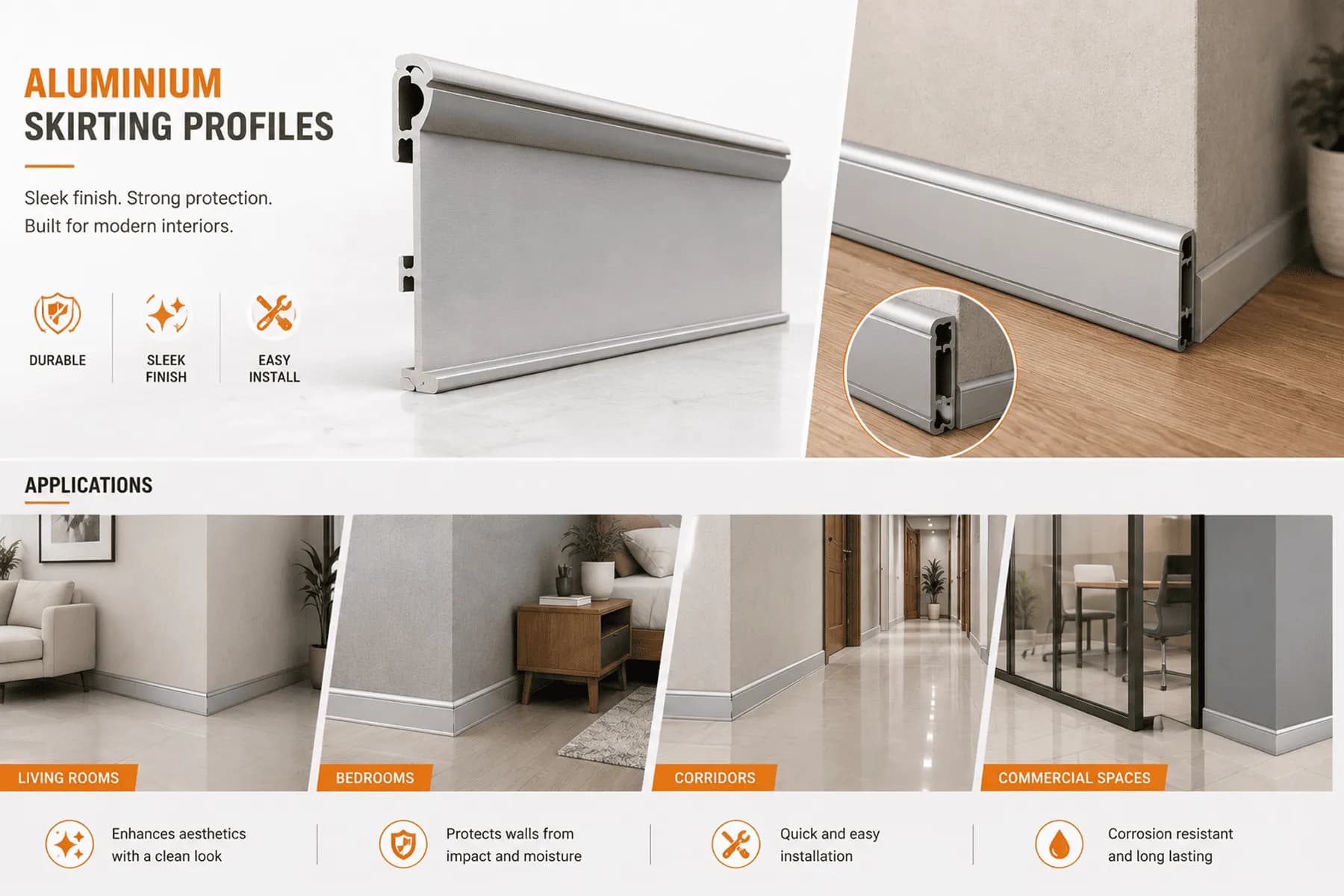
The strip where a wall meets the floor is one of the most overlooked details in an interior fit-out, yet it takes more daily abuse than almost any other surface — vacuum cleaners, mop water, moving furniture, scuffing feet. Wooden and PVC skirting boards have handled this job for decades, but both swell, discolour, or crack under sustained exposure. Aluminium skirting profiles solve the same problem with a slimmer, moisture-proof section that holds its line for the life of the building. This guide covers how to choose the right height, fixing method, and finish for a specific room, rather than defaulting to whatever height was used on the last project. Getting it right also has a commercial angle for contractors, since callbacks for swollen or cracked skirting are one of the most common post-handover complaints in interior fit-outs.
Choosing the Right Skirting Height for the Room
Height is the first decision, and it should be driven by the room's proportions and traffic, not habit. The 50mm profile suits minimalist spaces where the designer wants the skirting line to almost disappear against the wall. 75mm and 100mm are the most commonly specified heights for residential interiors — tall enough to give a clear architectural line without dominating a standard-height wall. 150mm is reserved for higher-impact applications such as commercial corridors, hospitality spaces, and hotel walkways, where the base needs to absorb more contact from trolleys, luggage, and heavier foot traffic. Matching height to context matters visually too: a 150mm profile in a small residential room can read as bulky, while 50mm in a busy corridor won't offer enough protection.
Height selection also interacts with skirting length planning. Since profiles are supplied in 3.0m and 3.66m standard lengths, a room's perimeter should be planned against those lengths to minimise offcuts and visible joints — a detail easy to overlook when height is chosen in isolation from the room's actual floor plan and corner count.
Why Fixing Method Affects the Finished Look
Unlike nailed or screwed timber skirting, aluminium profiles are fixed with a combination of high-strength adhesive and concealed mounting clips, which means the finished face has no visible screw heads breaking up the line. This matters most in minimalist interiors where an unbroken, continuous skirting line is part of the design intent — any visible fixing point draws the eye and undercuts that effect. The concealed-clip method also makes the profile easier to remove or replace during a future renovation without damaging the wall finish behind it, something wall-glued PVC skirting rarely allows without leaving adhesive residue or paint damage behind.
The fixing method also affects installation sequencing on-site. Because the adhesive-and-clip system doesn't require pre-drilling into finished wall plaster, skirting installation can happen later in the project timeline — after painting and flooring are complete — without the dust and touch-up work that comes with screwing into a finished wall. This flexibility is particularly useful on tight handover schedules where wall finishes are completed close to the project deadline. Cleaning is another practical difference worth mentioning to clients used to painted timber skirting: aluminium's non-porous surface wipes clean of scuff marks and cleaning-fluid splashes without absorbing moisture the way painted MDF eventually does, and it won't need repainting every few years to stay presentable — a maintenance saving that compounds across a large property or a multi-unit development.
- 50mm — minimalist rooms where the skirting line should read as understated
- 75mm–100mm — the standard range for most residential living spaces, bedrooms, and hallways
- 150mm — commercial corridors, hospitality interiors, and other high-traffic, high-impact zones
- Kitchens & bathrooms — moisture-proof construction makes any height suitable where wooden skirting would swell
- Finish selection — Silver or Black Matte for a visible design statement, Mill Finish where a neutral base is preferred
Clients rarely notice good skirting — they only notice bad skirting, once it's swollen at the bathroom door or scuffed white along the vacuum-cleaner line. Getting the height and finish right at the drawing stage is what keeps it invisible in the best way.
Colour and finish choice deserves the same attention as height. Standard Silver and Black Matte suit most contemporary interiors directly, while Mill Finish works well where the skirting is meant to recede rather than stand out — for example, beneath a floor-to-ceiling wall panel system. For larger bulk orders, custom RAL powder coating is also available, which matters for interior contractors trying to match a specific wall or flooring colour scheme across an entire building rather than a single room, rather than settling for whichever standard shade happens to be in stock.
Aluminium vs Traditional Skirting Materials
The upfront cost comparison usually favours PVC, but that comparison misses the lifecycle. PVC skirting tends to crack, discolour, or turn brittle well before a building's finishes are due for a refresh, while aluminium's anodized and powder-coated finishes hold their colour and resist the moisture damage that eventually warps wooden boards entirely. For interior contractors specifying across multiple rooms or units, this also means fewer replacement call-backs years after handover. This lifecycle advantage is most visible in kitchens and bathrooms, where humidity and regular mopping would otherwise be the first place a traditional skirting board begins to fail. Aluminium skirting pairs naturally with other detailing elements from the same interior & decorative range — matching T-profiles and corner guards — for a cohesive base-to-wall finish across a full interior scheme, all supplied wholesale in the same bulk lengths as the skirting profile range itself.