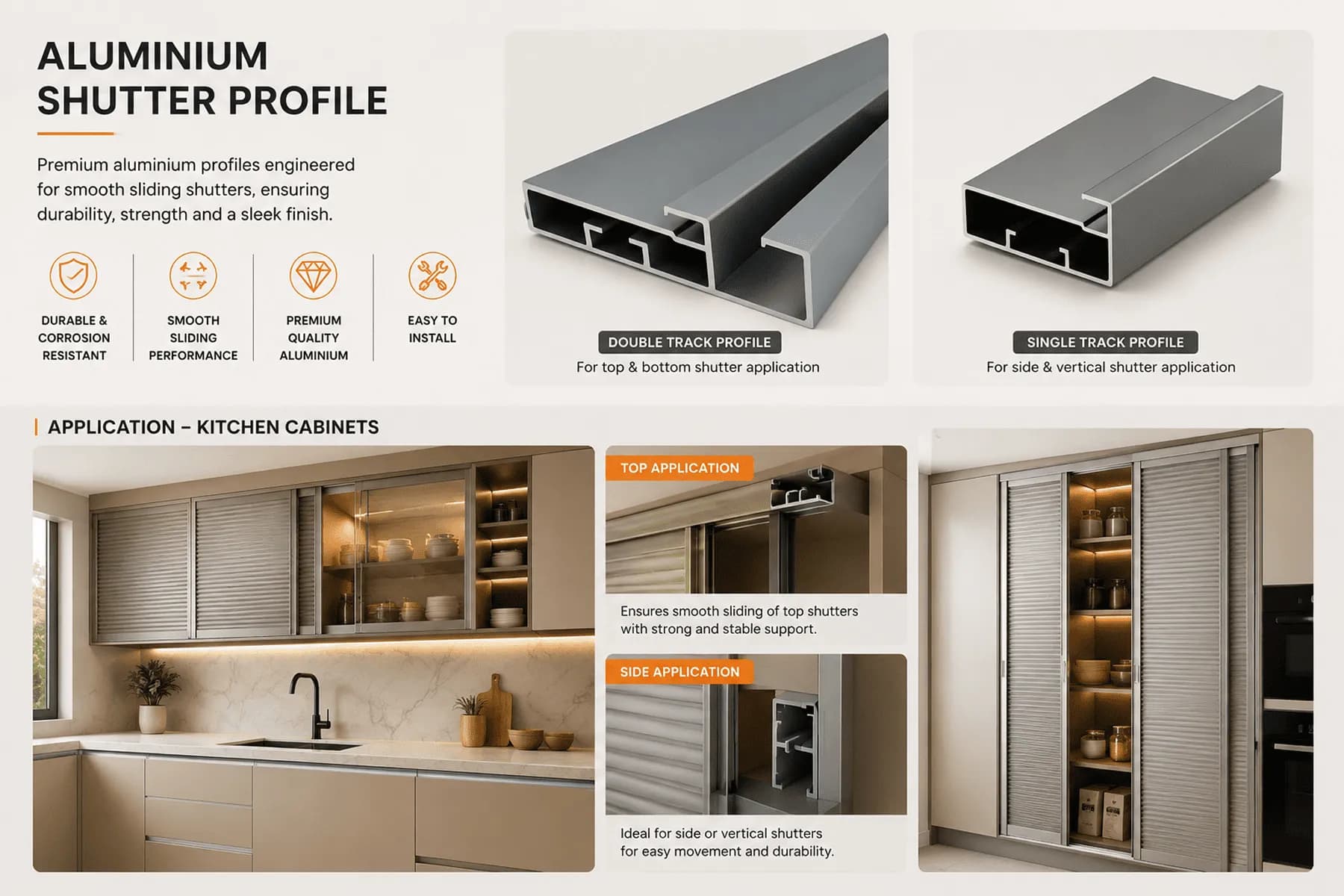
Glass-fronted cabinets put the frame on display in a way solid shutters never do — every mitre joint, groove line, and finish flaw is visible under kitchen lighting. Before specifying aluminium profile shutters for a glass cabinet run, a dealer or fabricator needs to check more than just frame width and colour. This buyer's checklist walks through the structural and finishing details worth confirming before placing a bulk order, so the glass panels arrive fitting the frame exactly as specified rather than needing rework after toughening.
Why Frame Choice Matters More on Glass Shutters
A solid laminate or acrylic shutter hides its frame construction behind the panel face, but a glass shutter frame is the entire visible border of the door. Beyond appearance, the frame is doing real structural work — it has to hold the glass edge securely, seal out dust, and support the full weight of the panel on its hinges over years of daily opening and closing. Getting the groove size, frame width, or load rating wrong is far more visible and more costly to fix on a glass shutter than on a solid one, which is why these checks are worth doing before the order is placed rather than after.
The Buyer's Checklist
- Frame width — confirm whether the design calls for the slim 20mm series for maximum glass visibility, or the wider 40mm, 45mm, or 50mm series for a bolder, more structural look
- Glass groove size — check the frame's groove accommodates your glass thickness; standard grooves are sized for 4mm to 5mm toughened or clear glass
- Height and weight rating — for tall or large display shutters, confirm the frame is rated to support the panel height, with reinforced sections rated up to 2.4 metres when paired with quality hinges
- Hinge and hardware compatibility — verify the frame's mounting dimensions suit your chosen soft-close or auto-close hydraulic hinges, and lift-up systems if applicable
- Joint finish — ask whether corners are seamless mitre-jointed, since a poorly finished corner joint is the first flaw visible on a glass door
- Finish and colour — decide between standard Silver, Black Matte, China Silver, or Gold, or whether a custom RAL powder coat is needed to match a brand or interior scheme
- Supply format — confirm whether you need long-length stock profiles or precision-cut sections for faster on-site assembly on bulk orders
Slim vs Wide Frames: When Each Makes Sense
The 20mm slim series is the right call when the design brief calls for maximum glass visibility and a minimalist border — typically the choice for contemporary crockery units and display cabinets where the contents are meant to be the focal point. The 40-50mm wide series carries more visual weight and reads as a deliberate architectural frame rather than a thin trim line, which suits statement display units or kitchens where the glass shutter needs to visually match heavier surrounding cabinetry. Neither width changes the underlying alloy or dust-proof sealing — the choice is purely about how much frame the design wants to show.
Why the Alloy Grade Behind the Groove Matters
It's easy to treat alloy grade as a footnote once frame width and finish are decided, but it's actually what makes the glass groove trustworthy in the first place. These profiles are extruded from 6063 T5 aluminium conforming to IS 733, chosen specifically for its surface finish and dimensional stability, since the groove holding the glass has to stay precise and consistent along the entire cut length. A section that moves slightly out of tolerance during extrusion can leave a glass panel sitting loose in one spot and tight in another, which shows up as a rattle or an uneven reveal line once the shutter is hung — a detail worth confirming with any supplier before committing to a bulk order.
Ask about the mitre joint before you ask about the finish colour. A frame that looks identical in a sample swatch can still show a visible seam at the corner once it's holding a full glass panel under kitchen lighting.
Ordering Mistakes Worth Avoiding
Most rework on a glass shutter order traces back to a handful of avoidable gaps between what was specified and what actually gets fabricated:
- Finalising glass thickness after the frame order is placed, instead of confirming the 4mm to 5mm groove fit beforehand.
- Assuming every finish is available in both the slim and wide series without checking the specific colour against the specific frame width.
- Skipping a check on hinge or lift-up hardware compatibility until the shutters are already on site.
- Ordering long-length stock only, when precision-cut sections would have sped up assembly on a large bulk order.
- Leaving custom RAL colour matching until after a standard finish has already been produced, adding an avoidable second production run.
Confirming these details before placing an order avoids rework once the glass has already been cut and toughened to size. For dealers who also need matching handles or shutter framing for solid panels elsewhere in the same kitchen, the full kitchen aluminium profiles range covers the complementary handle and frame systems that pair with a profile shutter installation.